
How does the council come to decisions
Image
Purpose: to retrieve information.
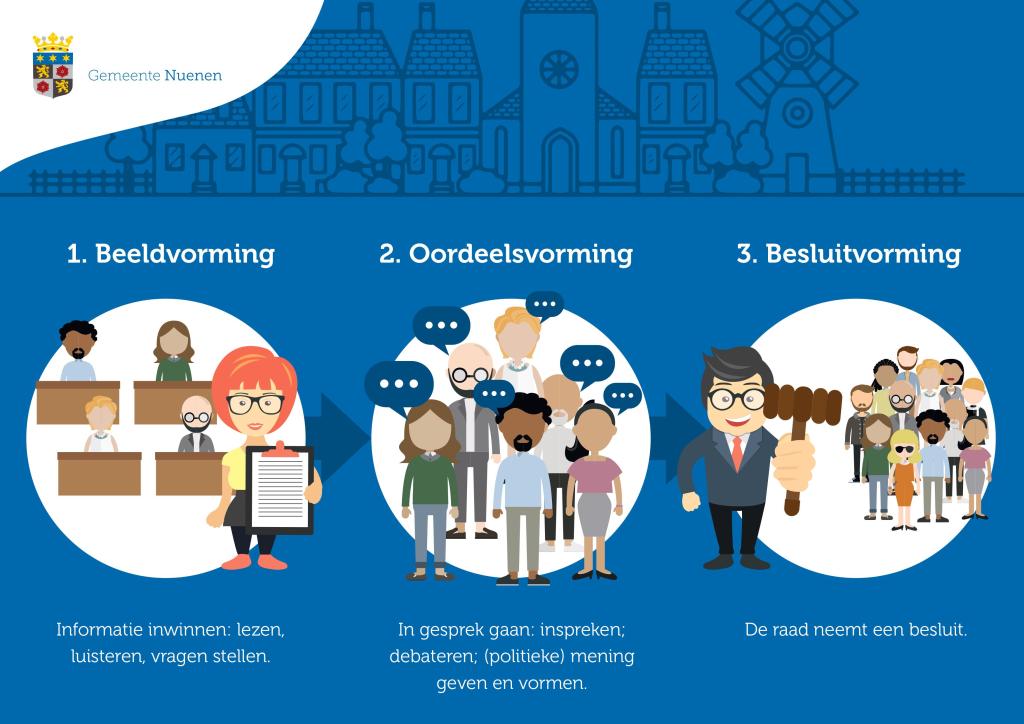
The council can form an opinion by reading documents and asking questions to each other, the residents (speakers), the board and the officials. Good listening and asking questions is important. The college will provide the necessary documents well in advance of this evening so that the council can prepare for this evening. During this evening, the college will give a short introductory presentation. This phase of the decision-making process is aimed at gathering information so that the council members can get a good picture of the social issue. The purpose is not to take positions or engage in discussion. The outcome of an image-forming evening is the basis for the judgment evening.
Judgment
Purpose: establish positions
The second step is judgment; the (political) debate. In this stage, council members take a (preliminary) position. Residents can also speak up on this evening and let it be known what they think of certain plans. Arguments are exchanged and people try to convince each other. The council can do this by having a debate between the (citizen) council members and/or the council members. The aim is to arrive at a (preliminary) position. This results in the recommendation for a hammer or discussion item.
A hammer piece is a meeting item to be discussed for which it is proposed (or determined) that it be approved without discussion or a vote. It is no longer discussed in the decision-making council. A discussion item is still discussed in the decision-making council.
Speaking Rights
The right to speak is only available during the image and opinion forming stage. During the opinion-forming stage, you can ask (factual) questions and inform the council. You can give your opinion during the opinion-forming stage.
Support for the speech with written material is possible. This is to be sent in advance to the Municipal Clerk’s Office. Please note that as a speaker you will also be pictured during a meeting. If you would like to exercise the right to speak, please register at Municipal Clerk’s Office
Decision-making (= council meeting)
Purpose: to make decisions
The final step is to make a decision. This is either a no-ballot item or the debate continues (discussion item), by submitting motions (requests to the college) or amendments (proposed changes). Council decisions are made in the decision-making council and are made by the votes of council members present. Decisions are made by majority vote. Council members may, if they wish, give an explanation of vote.
The mayor is the chairman of the council; the clerk sits next to the mayor during the council meeting and advises him. Councilors are not part of the council, but may participate in deliberations and answer questions.
Rules of Order
All rules on the conduct of meetings and other activities of the Nuenen City Council are laid down in the Rules of Procedure.
Open government
All meetings of the Nuenen City Council are in principle open to the public. However, as in any organization, subjects are occasionally raised that are not (yet) eligible for public discussion. Closed meetings, the imposition of secrecy regarding the discussion or written documents is only permitted on the grounds mentioned in Article 10 of the Government Information (Public Access) Act.