Investigation into unexploded ordnance at the Tomakker Cemetery
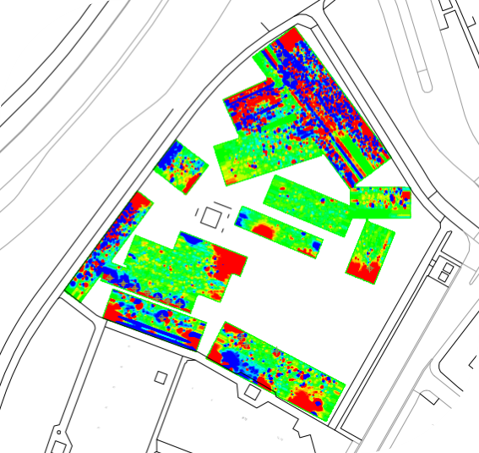
In 2025, Heijmans Infra—commissioned by the municipality of Nuenen—conducted a geophysical survey at the cemetery on Tomakker in Nuenen. The purpose of this survey was to discover what lies hidden beneath the ground without excavating the soil. This survey was conducted to better showcase the heritage site in the future. The survey went well, and the results are being incorporated into a report on the cemetery.
Following this investigation, the municipality received a report from a historian regarding the possible presence of wartime munitions in the soil of the plot near the Oude Toren cemetery. The documentation provided indicates the possible presence of buried munitions from World War II.
As a municipality, we have taken this report very seriously. We have sought advice from various experts, including the police and Heijmans Infra. Together, we have identified all possible risks. We have concluded that further investigation of the soil and, if necessary, removal of any materials present is required. This is necessary to rule out any risks to local residents, visitors, and future construction work. Safety is always our top priority.
Update September 10, 2026: Human skeletal remains found on the surface
The municipality recently received a report regarding the discovery of human bone material on the grounds of the former cemetery. In response to this report, we conducted a more detailed investigation of the site. There are currently many moles active on the site. They are bringing soil from deeper layers to the surface. As a result, bone fragments have indeed been exposed above ground. Since this is a former cemetery, we are handling this matter with care and respect.
Property enclosed by fences
To prevent visitors or children playing from coming into contact with bone material, the site has once again been fenced off as a precaution. The fences will remain in place for the time being, until a suitable and sustainable solution has been implemented. The fences have been installed solely because of the bone material that may come to the surface due to mole activity. There is currently no danger to nearby residents. The fencing is a precautionary measure to protect the site, prevent contact with bone fragments, and treat the human remains buried here with respect.
Research Results
In June 2026, a survey was conducted at the former cemetery to search for possible wartime munitions. No unexploded ordnance or traces thereof were found in the surveyed area during this investigation. However, archaeological finds were made during the work. Among other things, many very old graves were discovered outside the fences of the current cemetery. Remains of the former church and the old wall surrounding the cemetery were also found. You can download the archaeological survey report here:
Download the archaeological research report (PDF)
The study shows that some human remains are found very close to the surface of the soil. As a result, soil disturbances—such as moles digging—can cause bone fragments to be exposed at the surface. This appears to be the case now.
What's next?
As a municipality, we naturally want to handle this matter with care and are considering an appropriate solution. The presence of human remains requires not only a practical solution but also careful ethical consideration. These are people who were buried at this site long ago. That is why respect for the deceased and preserving the peace of their graves as much as possible are our top priorities. When selecting a permanent solution, we will also carefully consider how the site can be protected without unnecessarily disturbing the existing graves and human remains. That is why we are working with experts to determine which measures are technically feasible, sustainable, and ethically sound. In doing so, we are not only looking for a solution to the current situation but also considering the protection and future development of the entire area. The archaeological report prepared following the investigation offers several suggestions in this regard. As long as no final decision has been made and the necessary measures have not yet been implemented, the site will remain closed.
Did you find any bone material?
If you find any material in or around the cordoned-off area that you suspect might be human remains, please do not touch it and contact the municipality atm.stolk@nuenen.nl. We will ensure that the remains are reburied with respect.
As soon as we have more details about the measures that have been selected and the schedule, we will post this information on this webpage.
Update June 18, 2026 - investigation completed: no munitions found
The survey work has been completed. Heijmans did not find any munitions or traces of them in the surveyed area. However, archaeological finds were made during the work, including parts of the old wall of the cemetery and church.
Heijmans will now prepare a report detailing all the findings of the ammunition investigation. Once this report is available, we will be able to share more detailed information. Information about the archaeological finds will follow as soon as more details Map published in Map .
A Look Back at the War Munitions Investigation: What Have We Done?
We commissioned Heijmans Infra to conduct a survey to confirm whether there is actually wartime munitions in the ground. The survey began on Monday, June 1, 2026. First, the survey area was cordoned off with fencing. Based on the results of the previous survey, Heijmans carefully excavated the soil. Two archaeologists were also present during the survey to protect any archaeological finds.
Questions and Answers
Why do you think there is wartime ammunition buried in the ground?
Following the geophysical survey conducted in 2025, the municipality received a report from a historian indicating that there may be wartime munitions buried on the plot of land near the Oude Toren cemetery. The documentation provided indicates the possible presence of buried ammunition from World War II. The document in question is a 1943 police report from the military police, signed by the then-mayor of the municipality of Nuenen.
What does the study involve?
Heijmans Infra will conduct a survey to determine whether there is actually any unexploded ordnance in the ground. The survey will begin on Monday, June 1, 2026. We expect the survey to take 5 to a maximum of 14 days, depending on the results. The survey area will first be cordoned off with fencing. Based on the results of the previous survey, Heijmans will carefully excavate the soil (layer by layer). They will use a midi crawler crane for this purpose.
An archaeologist will also be present during the investigation to protect archaeological sites.
What happens if live ammunition is actually found?
As soon as something resembling wartime debris is discovered during excavation, Heijmans immediately contacts the police and the Explosive Ordnance Disposal (EOD) unit. The EOD then takes over the entire process.
The police and the EOD have extensive experience in this area and operate in accordance with strict safety requirements, with their own safety and the safety of the surrounding area naturally being the top priority.
If it is necessary for safety reasons to evacuate (part of) the area, the police will take the necessary measures and provide information to the surrounding community.
Exactly where will the digging take place?
The locations where excavation will take place are marked by the blue and red dots. This does not involve the current cemetery. Heijmans will begin the survey and excavation work in the southernmost part of the plot.